
The practical part
A day with Memorate
The app tells you what is up. This page is about when and in what order to do it, so that something comes of it.
It is a recommendation, not a rule. Memorate does not record that you did it differently, and takes nothing away from you for it.
Day zero
The first day is all drill
The first day looks nothing like the rest, and it catches almost everyone out: there will be no test today.
A committed card gets its first due date tomorrow or the day after — it has no way of reaching today's test. It does show up in today's drill straight away, and that is your whole day.
The drill gets the introductions over with: you see every new card at least once before tomorrow tests it for real.
Do not commit everything at once
What you commit today comes back in a few days — all of it, at once. A thousand cards on Monday means a thousand cards on Wednesday, and then nothing ever again, because you will have given up. Fifty a week is a pace that holds for years.


Get some cards
A bundled deck, a download from the web, a CSV import or by hand.
Commit them
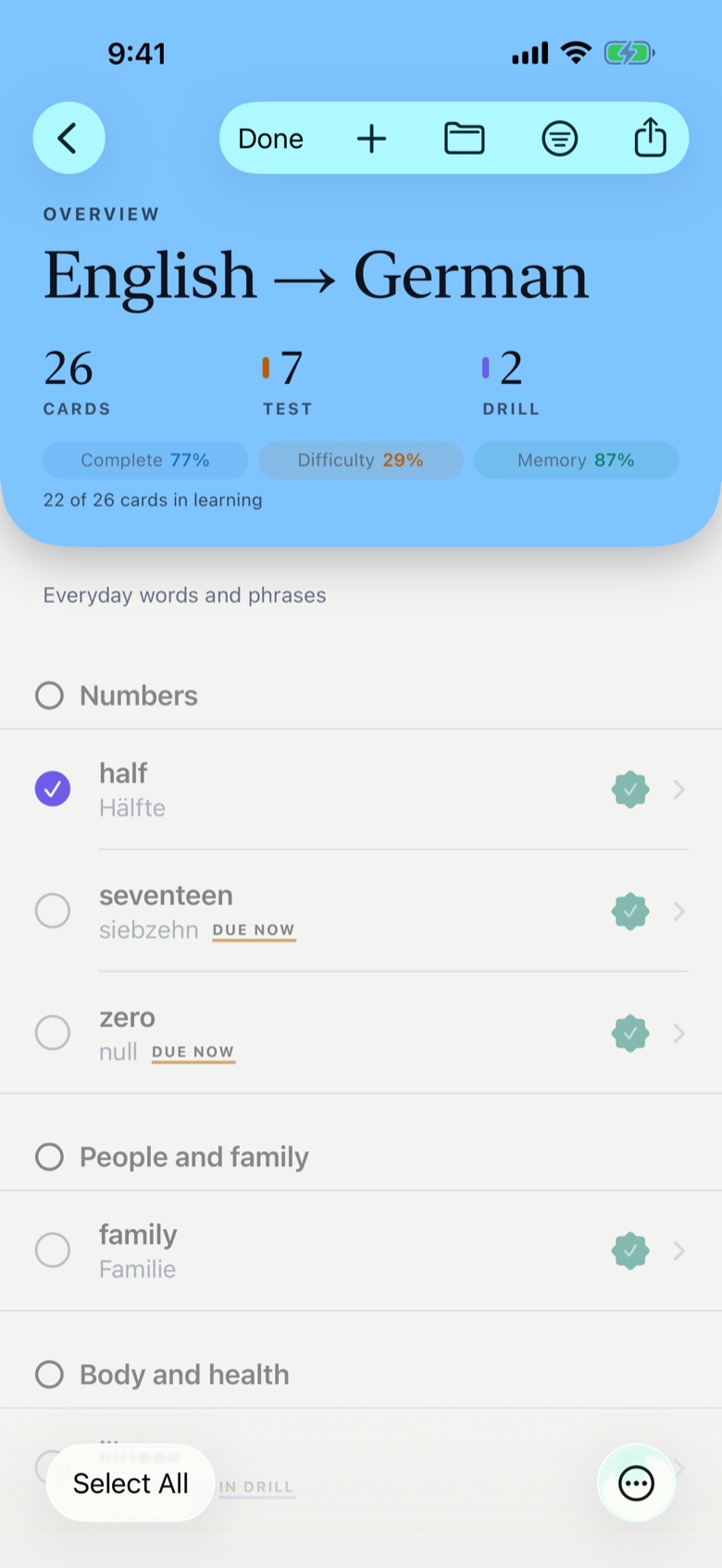
An imported card does not learn itself. Committing is how you say you want to learn this one.
Clear today's drill
The queue is exactly what you have just committed. Empty it and the day is done.
Day one and on
An ordinary day
From the second day the order never changes, and it runs from what has a due date to what does not.
Test in the morning
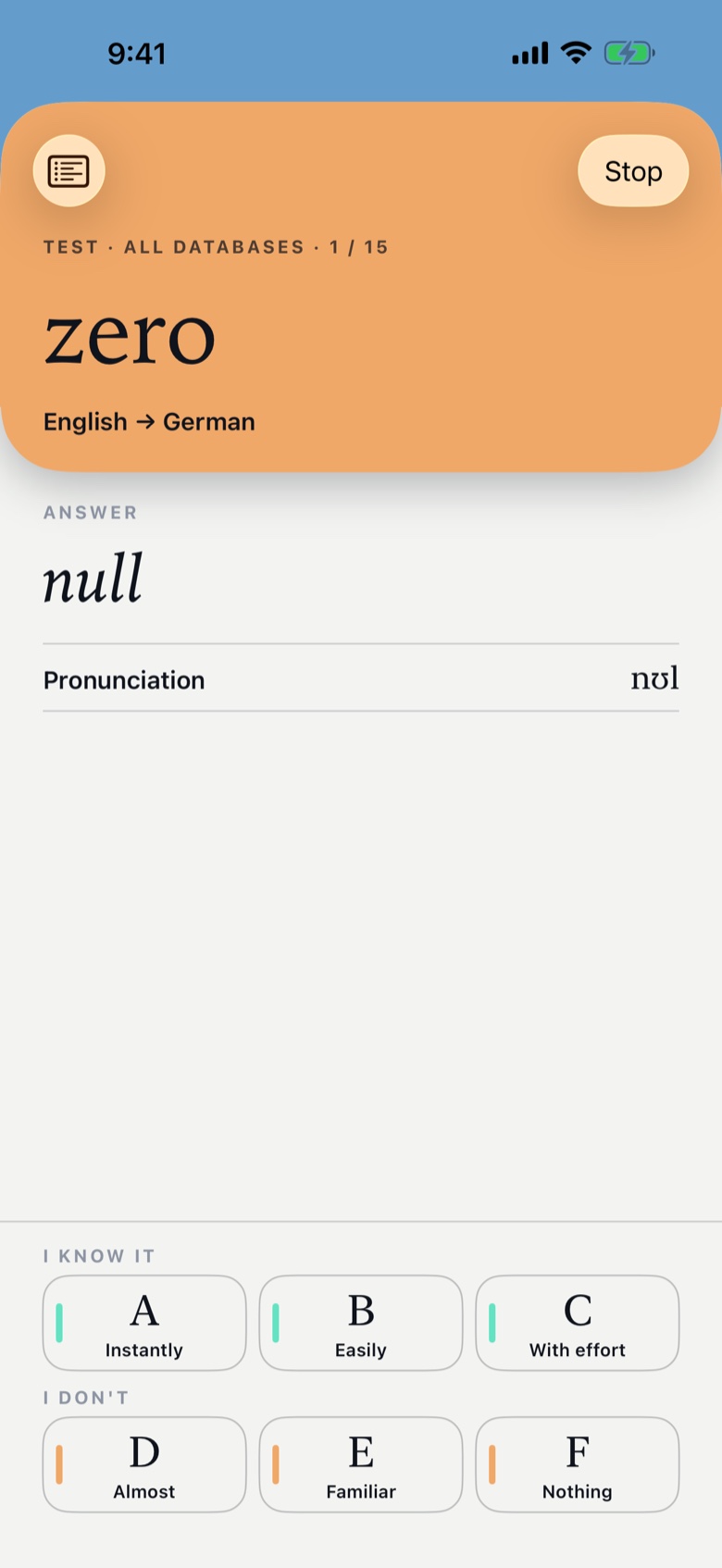
Start with the test, not the drill. A test has a due date — a card is in it because the model says it is balancing on the edge of being forgotten right now. Leave it lying there and it keeps fading, and costs you more next time.
The drill has no due date. It will wait.
Do not reveal before you try
The whole model rests on the grade measuring recall, not impression. Look first and tell yourself you knew it, and you get absurdly long intervals — and then you wonder why.

Drill later, with a gap
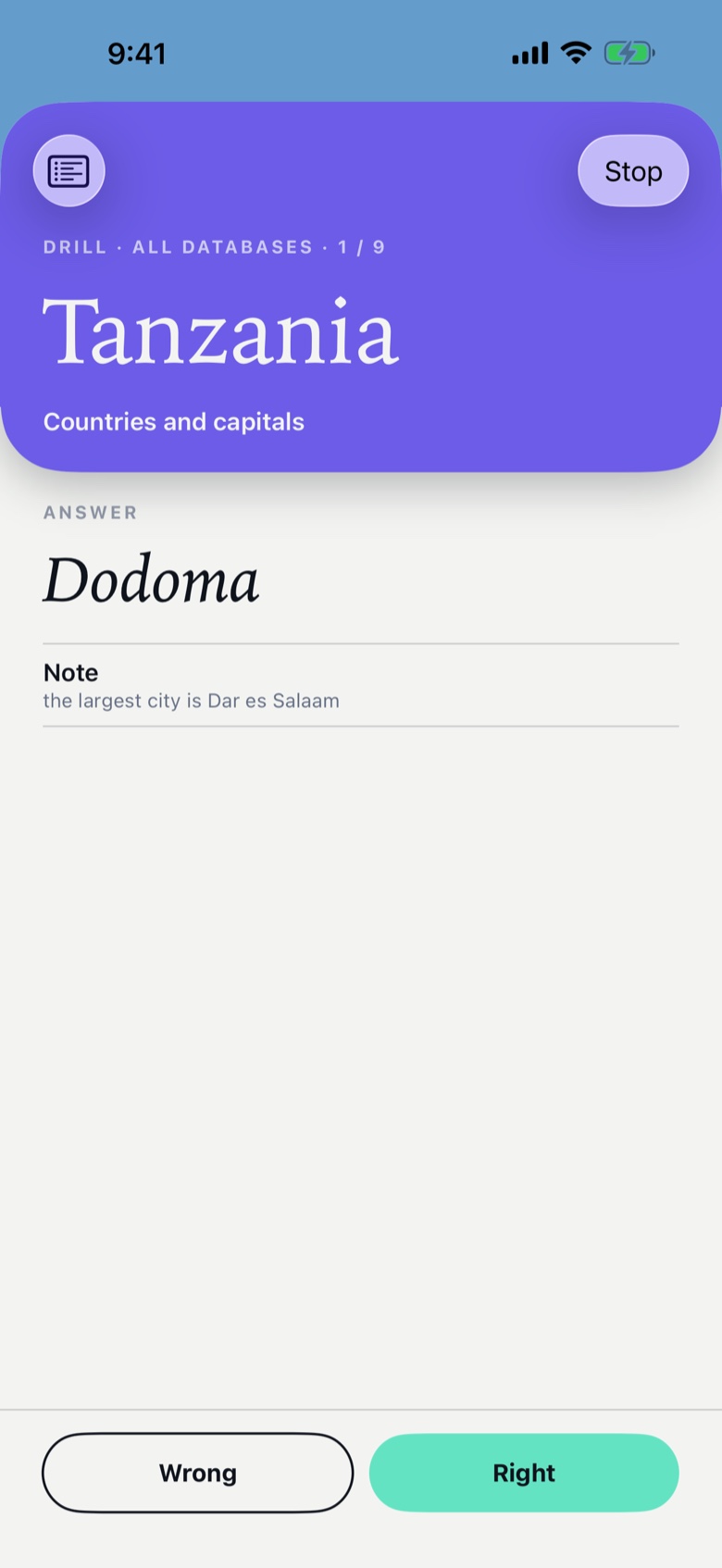
The drill holds everything that fell below C in the test. It is today's tidying up, not planning — the drill touches neither the due dates nor the memory model.
Do not do it right after the test. An answer you recall five minutes later comes out of short-term memory and does almost nothing for tomorrow. Let it sit a few hours — lunch, the way home, the evening.
A recommendation, not a measurement
The forgetting curve compares reality against the prediction, but the timing of the drill cannot be read out of it. It rests on how the model works, and on spacing generally being good for memory.

New cards last
Add them at the end, not at the start. Commit in the morning and you have added today's drill and tomorrow's test on top of what was already waiting — deciding tomorrow's load before you know how today went.
When you are done and the appetite is still there, that is the right moment. When it is not, the answer is just as clear.

Empty in the evening
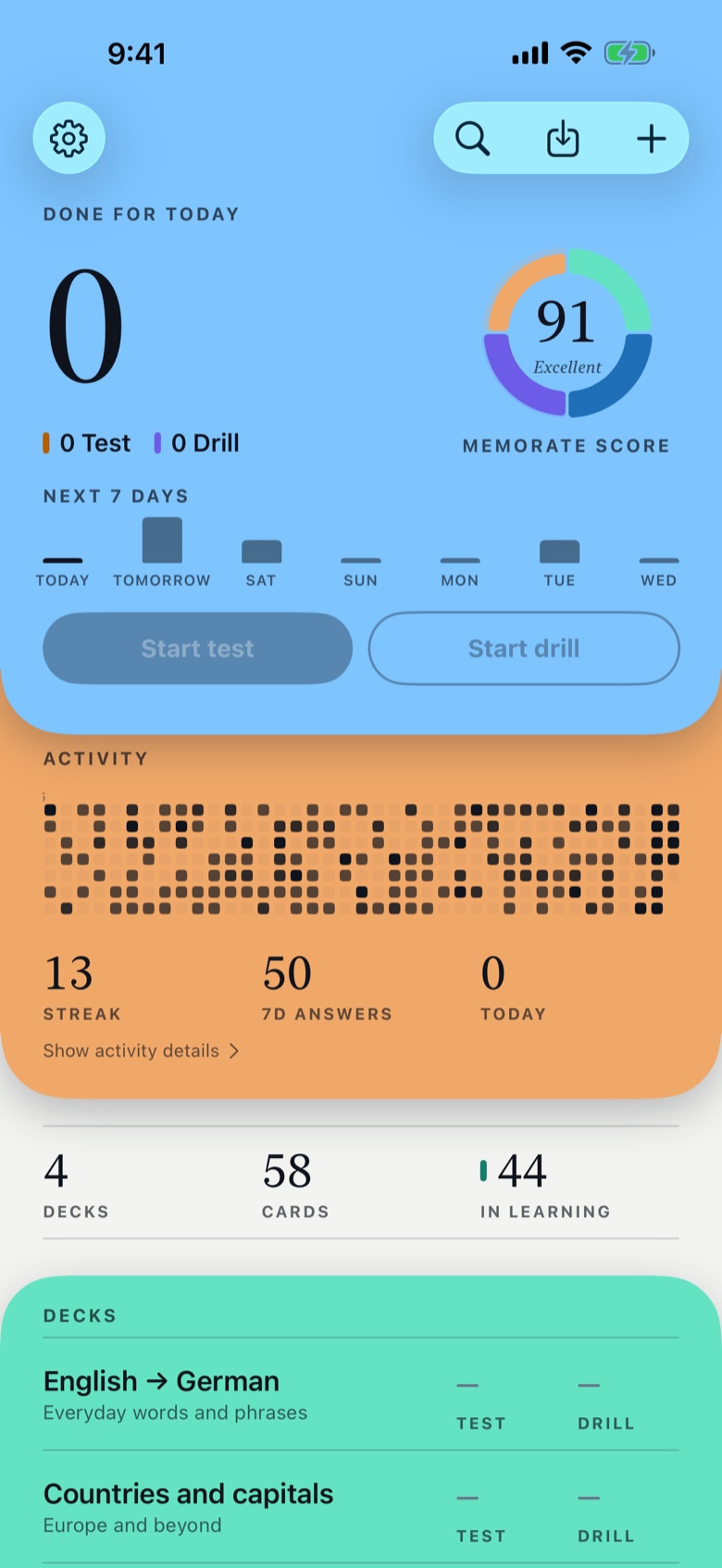
The goal of a day is not a number. It is an empty queue.
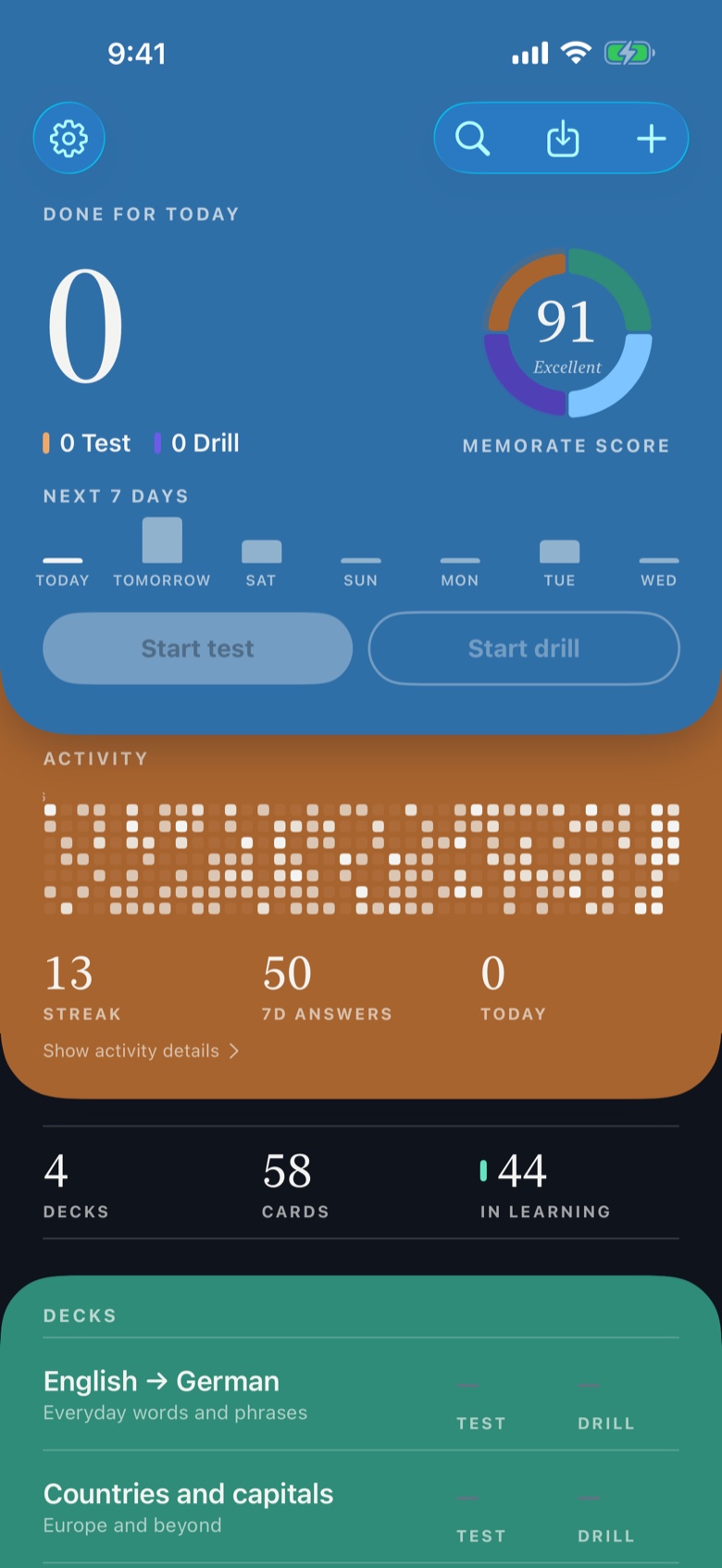
The Memorate Score grows on its own while you do that — it is a consequence, not a task. Chase it by committing more cards and you work against yourself: the queue grows and Rhythm drops.
Why this order
There is nothing mysterious about it. It runs from what has a due date to what does not — because only a due date can be missed.
| Step | Has a due date? | What happens if you skip it today |
|---|---|---|
| test | yes | the card stays due and piles onto tomorrow — and keeps fading meanwhile, so it costs you more next time |
| drill | no | the card stays in the queue until you clear it; it piles up just the same, only nothing gets worse |
| new cards | no | nothing — what you do not commit has nowhere to pile up |
None of it expires. The queue is never wiped and cards do not vanish from it — it just spills into the next day.
How much time a day
It is not governed by a number of cards but by time. Twenty minutes every day beats two hours on Saturday — and that is not an opinion, it is the entire reason spaced repetition works.
When the daily load grows past what you can manage: stop committing new cards, keep clearing the tests, and the queue falls by itself. Spaced repetition cannot be caught up on; it can only be kept up.
When it piles up
After a week off, a heap is waiting. It is unpleasant but not bad — and above all it is not solved by deleting.
Clear it in pieces. What you forgot drops into the drill and comes back sooner; what you still knew after an extra week gets a longer interval than it would have got on time. Twenty minutes a day for a week levels even a serious heap.
After a month
What to look at once it has been running
Until then, do not look at the statistics. Two hundred answers say nothing, and a number that means nothing only makes you nervous.
The forgetting curve
It says whether the model fits your memory. When it misses consistently, the intervals are too long or too short.
Memorate Score
It shows which of the four components is dragging — and the trend chart under it, what is moving it.
In short
- Test in the morning. It has a due date.
- Drill in the afternoon or evening. With a gap, not right away.
- New cards last. If the appetite is still there.
- Empty in the evening. That is the goal of the day.
- Do not commit faster than you clear. This is the one mistake that takes weeks to undo.
The technical detail for every step is in the manual.