 Memorate
This chapter is not required to use Memorate. It is for people who want to know why it computes what it computes.
Three numbers
For every learning direction Memorate keeps:
| Range | Meaning | |
|---|---|---|
| Difficulty | 0 to 1 | how demanding this thing is for you |
| Stability | days | roughly how long the memory trace lasts |
| Recall estimate | 0 to 1 | how likely you are to recall it right now |
The recall estimate is computed from elapsed time and stability. It falls on its own as time passes — which is why a card eventually becomes due even though nothing happened to it.
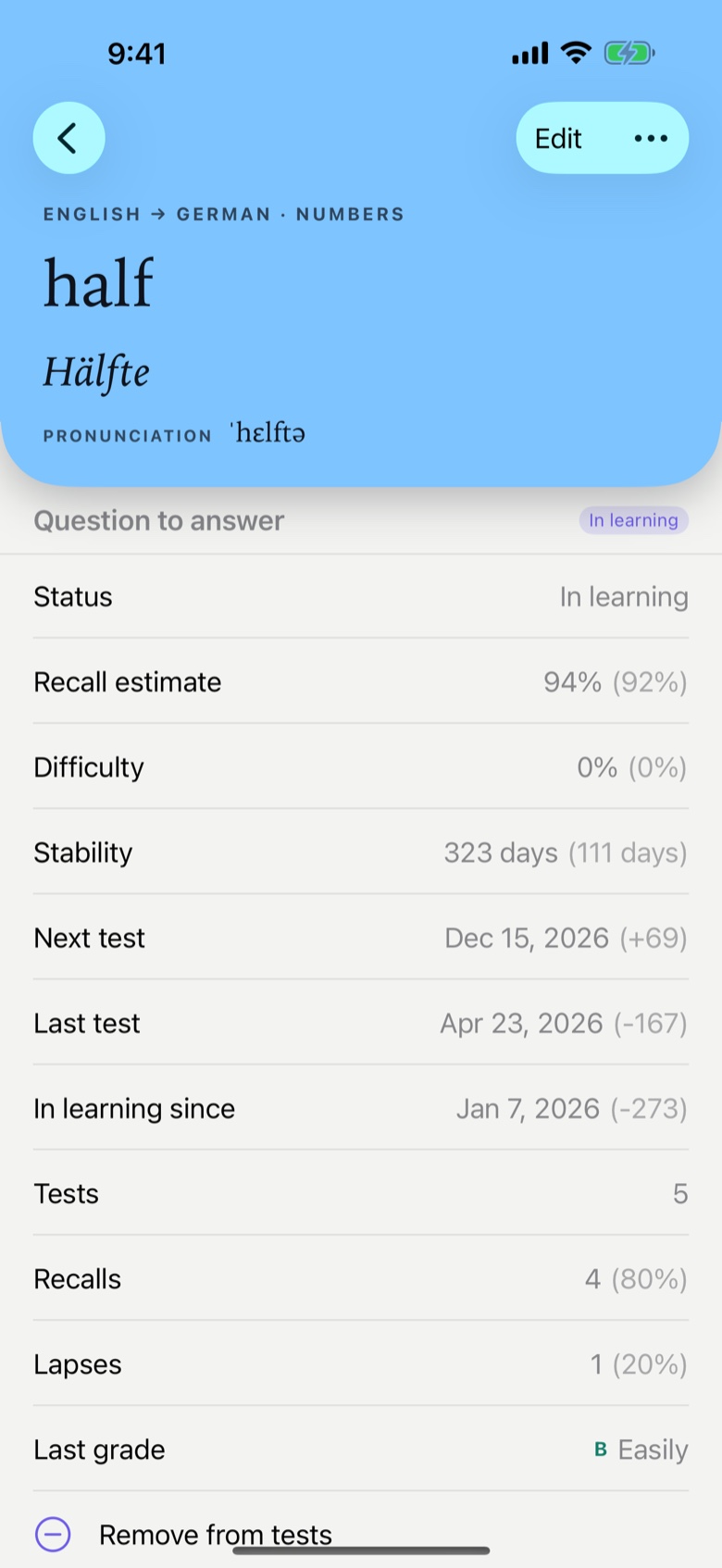
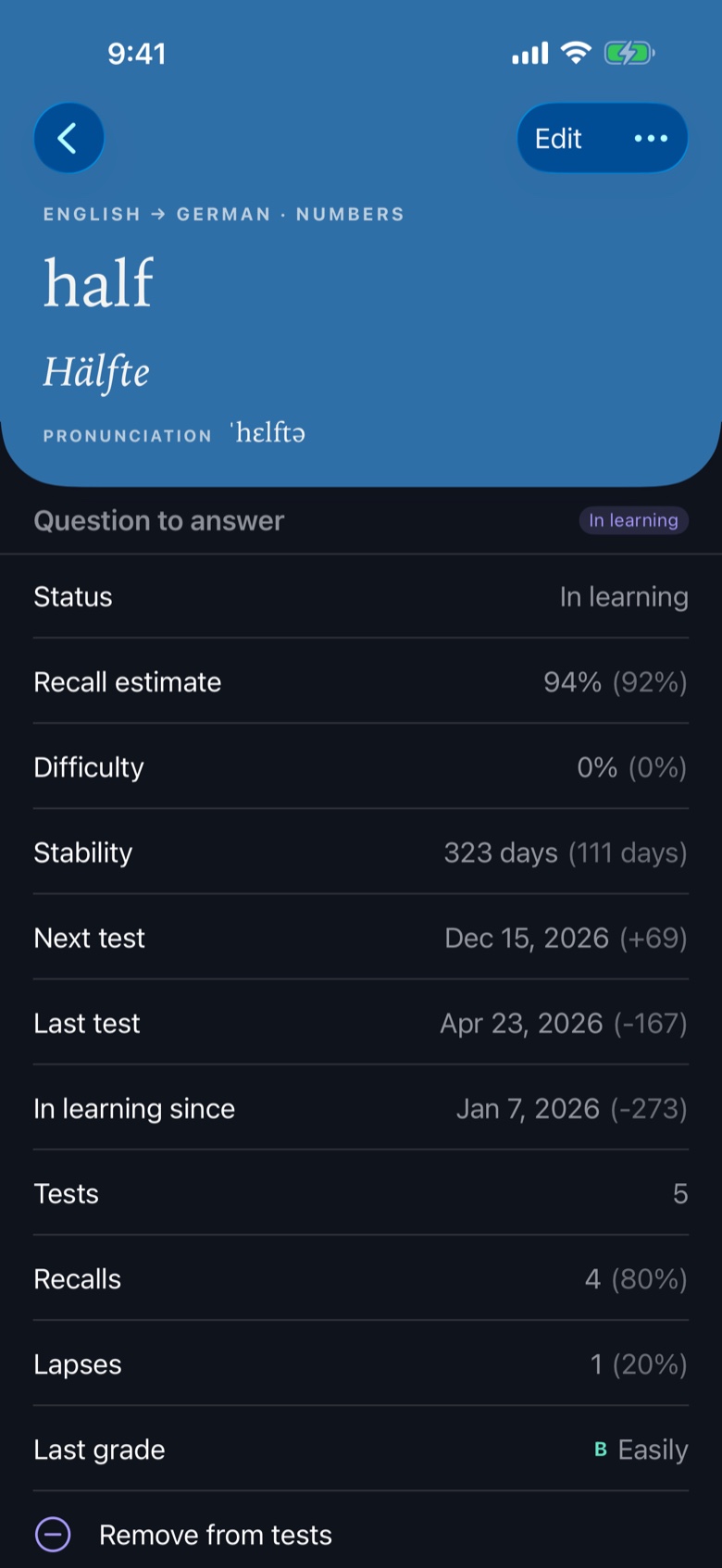
The key property: when exactly as many days pass as the stability, the recall estimate is 90 %. Stability therefore corresponds to the interval after which you are still very likely to remember.
When a card comes back
The due date follows from the target retention set on the deck. Memorate works out when the recall estimate will fall to that threshold and schedules the card for that day.
- A higher target (95 %) → shorter intervals, more reviews, less forgetting.
- A lower target (85 %) → longer intervals, fewer reviews, more forgetting.
The date is then scattered
The calculated day is not the final word. Memorate opens a small window around it and draws the date from there — otherwise a batch committed on one day would keep coming back together and the outlook would grow spikes.
The draw takes what already waits on each day into account: the more work sits there, the smaller the chance this card lands on it too. When the days carry the same load, it stays ordinary randomness.
That is why the first review after committing does not arrive for every card at once, but splits between tomorrow and the day after.
What each grade does
| Grade | Stability | Difficulty | Drill |
|---|---|---|---|
| A Instantly | grows the most | drops slightly | no |
| B Easily | grows | drops slightly | no |
| C With effort | grows a little | rises slightly | yes |
| D Almost | falls | rises | yes |
| E Familiar | falls further | rises more | yes |
| F Nothing | falls the most | rises the most | yes |
The important part is that a lapse does not erase history. The card does not go back to the start; its stability drops and the next interval is shorter.
Longer gaps pay off
Recalling something after a long gap strengthens memory more than recalling it after a short one. Remember a thing after a month and stability grows more than if you had peeked after two days. That is why reviewing things "just in case" before they are due does not pay — and why the drill, which never touches the schedule, exists.
Difficulty reverts to the mean
Without that, a card would get stuck at maximum difficulty after a few unlucky answers and there would be no working it back down. Difficulty is therefore pulled gently towards the middle after every answer.
Six grades, four levels
The FSRS model has trained weights for four answer levels. Memorate has six. They are merged only at the input to the calculation:
| A | B | C | D, E, F |
|---|---|---|---|
| Easy | Good | Hard | Again |
In the interface, the journal and the history, the full A–F scale is kept. Partly because it is more precise feedback for you, partly because it collects the data from which a six-level variant can one day be trained.
Checking whether it fits
Whether the model matches your actual memory can be checked on the forgetting curve. If cards are recalled worse than predicted, intervals are too long — and the other way round.
What does not affect the schedule
Memorate Score, the activity grid and the streak do not influence intervals. They are analytical and motivational layers and stay out of scheduling. Neither does the drill.
Where this comes from
Memorate follows on from SuperMemo but uses the more modern FSRS-6 model. The six-grade scale and the separate drill are carried over from the original app because they worked.